

Floyd Davis
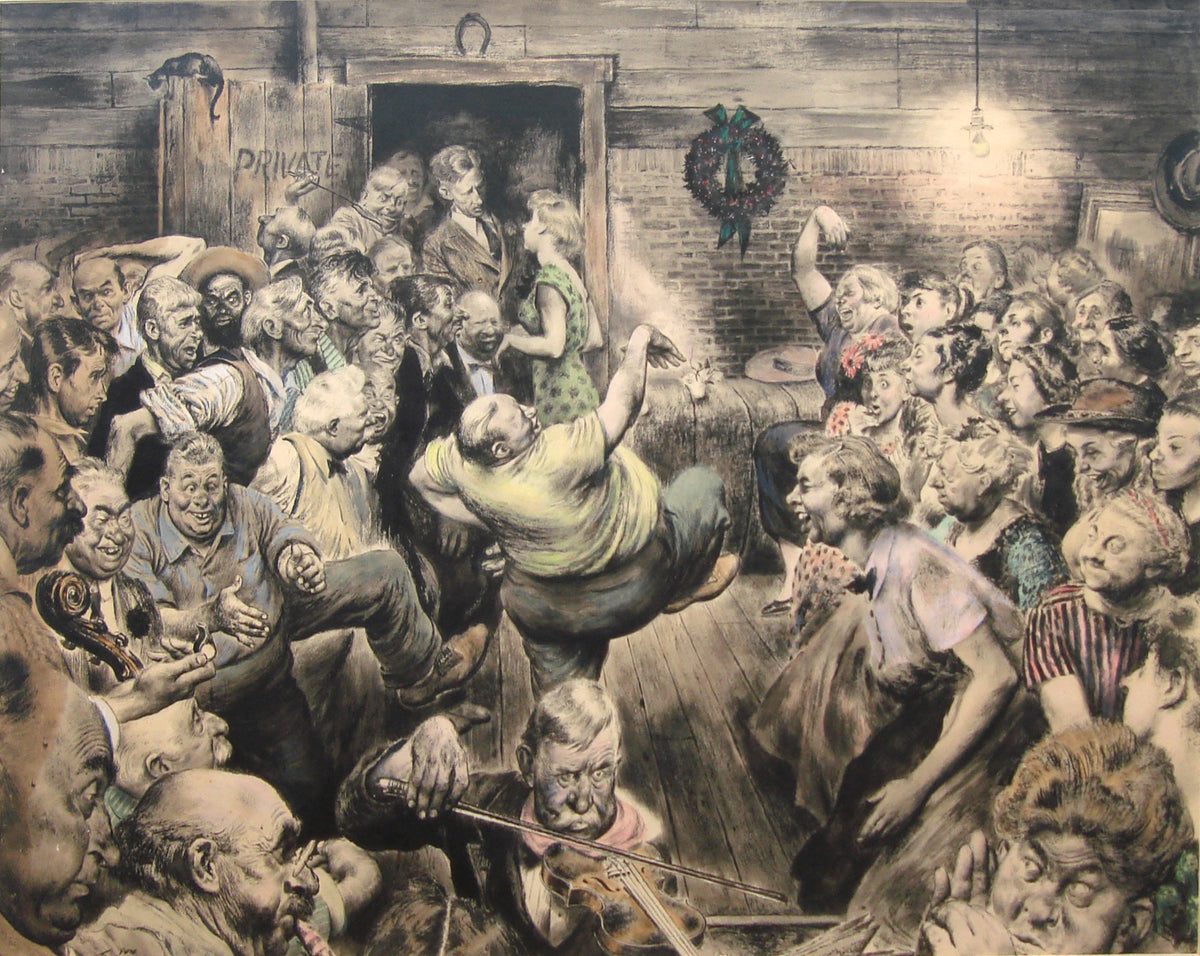
American illustrator Floyd MacMillan Davis was noted for his depictions of southern rural hill people and country folk. He gave much of the credit for his success to the critical judgement of his wife, painter Gladys Rockmore Davis. Floyd Davis had a unique way of seeing and painting the American scene and his poetic social realism reflects a warm, human spirit and humor that is common to the everyday person. Relying on his memory and imagination, Floyd Davis was a remarkable able draftsman who could draw almost anything instantaneously with vigor, accuracy and ease. His early years were spent as an illustrator for magazines and advertisements and he became famous for capturing the lofty hauteur of the society types he drew.
During the 1930s, Floyd Davis illustrated stories for which he took subjects and figures from rural and hill people for authors William Faulkner, Sigman Byrd, Glenn Allan and MacKinlay Kantor. Although publishers and authors had no idea he was doing it, Davis added humorous realistic cats, flies and lizards to scenes to animate them and intrigue people and that element in his illustrations brought him fame and fortune.
During WWII, Davis was chosen as an artist war correspondent for the War Department and painted in several war theaters. Many of these on-scene illustrations of the war were published by Life magazine during the 1940s and served as a pictorial record of the war. Some of these works on paper hang in the Pentagon, Washington, D.C. Davis won numerous awards from the Art Directors Club, was highly admired by his peers, and he is considered one of the great figures of American illustration.
Reference: The Illustrator in America, 1880-1980, Walt & Roger Reed.